Wednesday, November 21, 2012

Monster Prints


This unit of study for 2nd through 5th Grade was centered around two things, monsters and printmaking, and was a week long placed conveniently at the end of the month of October. Printmaking was done with white and white-tinted colors of acrylic paint on black paper. The printing block was a small styrofoam block, and the process utilized was relief, a subtractive engraving process, much the same as wood block printing. 


The first part of the unit was studying the Caprichos intaglio print series created by Francisco Goya.
The classes took notes about Goya and his series of twisted and dark prints. 


Though in all truth, the historical context and subversive meanings of these prints is of some more mature content, the classes still learned about Goya's place in the Enlightenment Era, his opposition to society in Spain, and his views of the clergy. They learned about how Goya used monsters and creatures to represent allegories pertaining to his concerns and critiques of society.


Next, they spent some time brainstorming some monster ideas of their own in their sketchbook. Then they were taught how to use a styrofoam block to make a plate or block for printing an edition of prints. Here are some of the results:


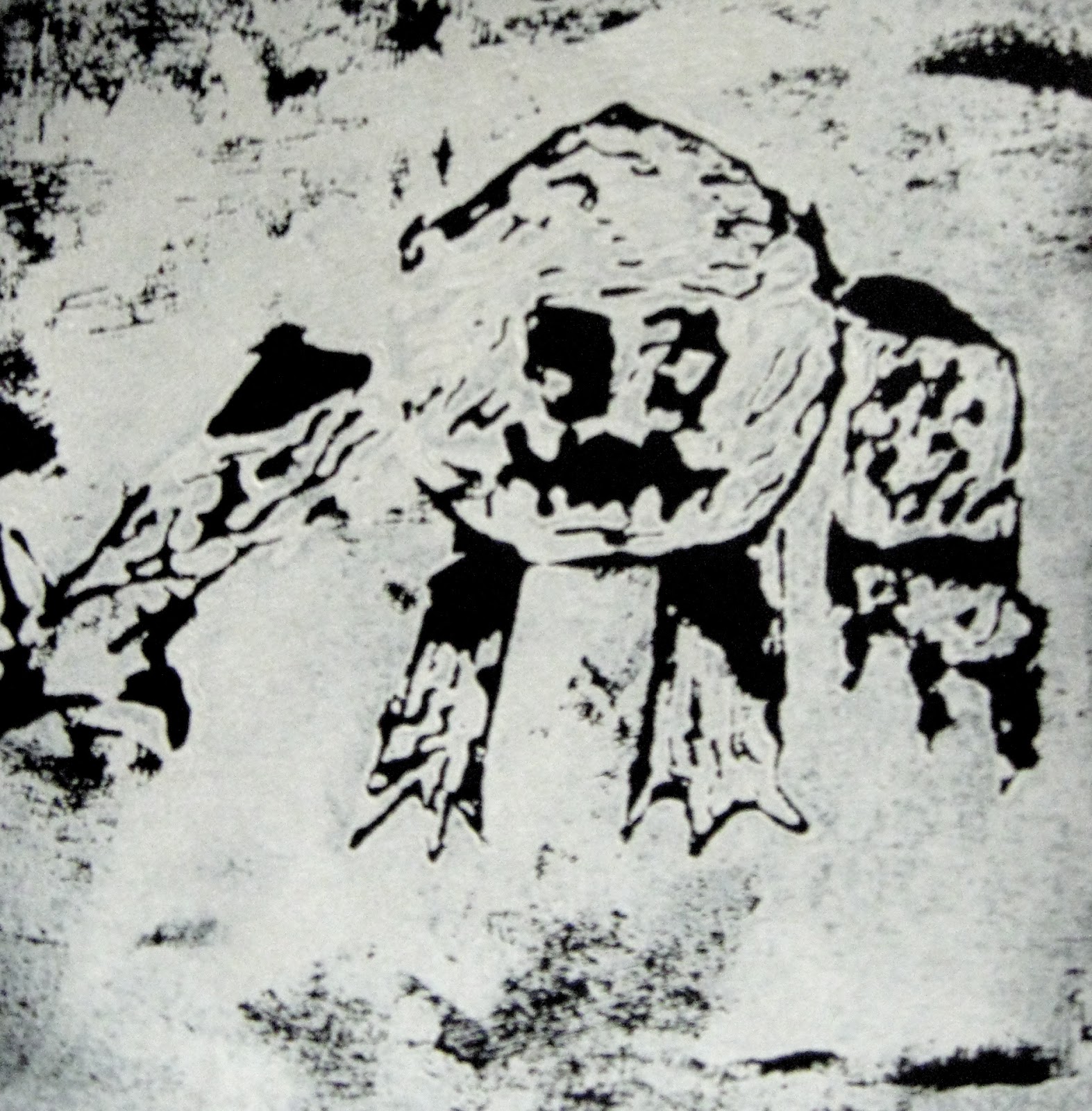


After all the 2nd through 5th Graders were done printing an edition of six prints, each, they chose their best one from the edition to be left on display at school. The other five were given to them to trade, keep, and give to family and friends.

The 4th and 5th Graders got to make a larger group piece that you see below, a simple checkered collection of every student's print.


Kindergarten and 1st Grade did a form of printing monsters, too, but skipped the dark lesson on Francisco Goya. In lieu of the art history lesson, they studied symmetry.


The project was simple. Each kid got a manila piece of paper, drizzled a little black paint on it, folded it in half, reopened it, observed the symmetrical picture created by the paint, and took a pen and colored pencils to it to create a monster in the image they saw. Then they did the same thing with white paint and black paper.


A symmetrical face of some sort was encouraged, looking for something that may represent eyes, ears, a mouth, a nose, and so on.


Thursday, November 15, 2012

Ties: Lines, Patterns, Repetition, Lines, Patterns, Repetition, Lines, Patterns, Repetition, Lines, Patterns, Repetition...


This project was centered around the elements of LINE, PATTERN, and REPETITION. The hook that pulled things together between the different grade levels was that everything was tied to painter and printmaker, Wayne Thiebaud and his artwork like the piece shown below. The classes began the project by hearing about Thiebaud and seeing many examples of his work. They were also shown other artworks and were challenged to identify lines and patterns they could see.


The classes then practiced drawing lines in their sketchbook. They were allowed to start out easy with straight and dotted or dashed lines, but were quickly challenged to create progressively harder lines. The level of difficulty varied based on age.


After this, they drew a row of ties with a 2H pencil on watercolor paper and gave each one a different pattern of lines. Once they had a sufficient grasp of patterns and repetition and were able to execute their understanding through their preliminary sketch, they were given a 6B pencil to redraw the ties darker. This was followed by coloring the ties with colored pencils and watercolor painting the background, including painted shading.


The examples above are finished works by 4th Graders. Our 2nd and 3rd Graders did bow ties in lieu of neck ties. Fifth Grade did neckties, as well, but cut out the neck ties from construction paper and glued them to a black piece of paper with white shadows.

Monday, November 12, 2012

De Stijl Color Study


In this study, 4th and 5th Grade practiced color mixing, learned about Piet Mondrian's take on De Stijl painting, and incorporated the mathematics of fractals in the form of a square divided into fractions whose sum infinitely approaches "one." "


To start, the classes watched this video: "infinity elephants" from Vi Hart

Next, they studied De Stijl and Piet Mondrian.


Then they used a fractal series to draw up and paint these:


After this practice with acrylic paints using primary colors plus black and white, the classes studied paint mixing. On a work sheet, they painted the primary colors, secondary colors, tints, and shades.


This all culminated with a multi-class mural made from the protective white paper that had been laying underneath their projects the whole time. The 4th and 5th Grade classes turned the huge butcher paper into their own Piet Mondrian-esque painting using their recently acquired knowledge of color theory. The results are as follows, and only took roughly four hours to finish between the classes.


Thursday, November 1, 2012

JUNGLE ART

To begin this unit of study, Mr. Mueller asked the classes a few questions about their general knowledge of rain forests and jungles; then he presented a few paintings of jungle scenes including a particular jungle painting by Henri Rousseau.


After pointing out the variety and abundance of leaves in all the jungle scenes, the class was presented with boxes of six different specimens of leaves from different trees. In their sketch books, they made green crayon rubbings of each leaf and then sketched the leaves exactly as they observed them. Details varied by the grade level. 


In addition to a study on leaves, Mr. Mueller led the classes in a demonstration on sketching exotic animals. With the kids following along in their sketch books, Mr. Mueller drew a variety of animals, step by step, at the front of the class.


And to put it all together, the classes were next assigned to compile what they learned about plants and animals into a jungle drawing. Mr. Mueller also emphasized composition, pointing out how to get a foreground, middle ground, and background through layers. Here are some of the results.